While Montessori-based research is a growing field, modern studies often provide fascinating insights into how we can continue refining our practice. Today, we are excited to share a summary of a recent study focusing on music education and auditory discrimination in Primary classrooms.
We found the findings deeply aligned with our commitment to balanced sensory development, and we thought our St. John’s community would find it equally compelling.
The Sensory Balance in Early Childhood
Dr. Maria Montessori observed that early childhood—specifically up to age six or seven—is a critical window for sensory development. During this sensitive period, children possess an extraordinary capacity to refine their senses, including their ability to discriminate pitch, tone, and rhythm.
In their published study, A Child-Directed Music Curriculum in the Montessori Classroom, researchers Diana R. Dansereau (Boston University) and Brooke M. Wyman (Primary Guide) explored a common observation in modern early childhood environments: over time, classrooms have come to rely more heavily on visual sensory materials than on auditory ones.
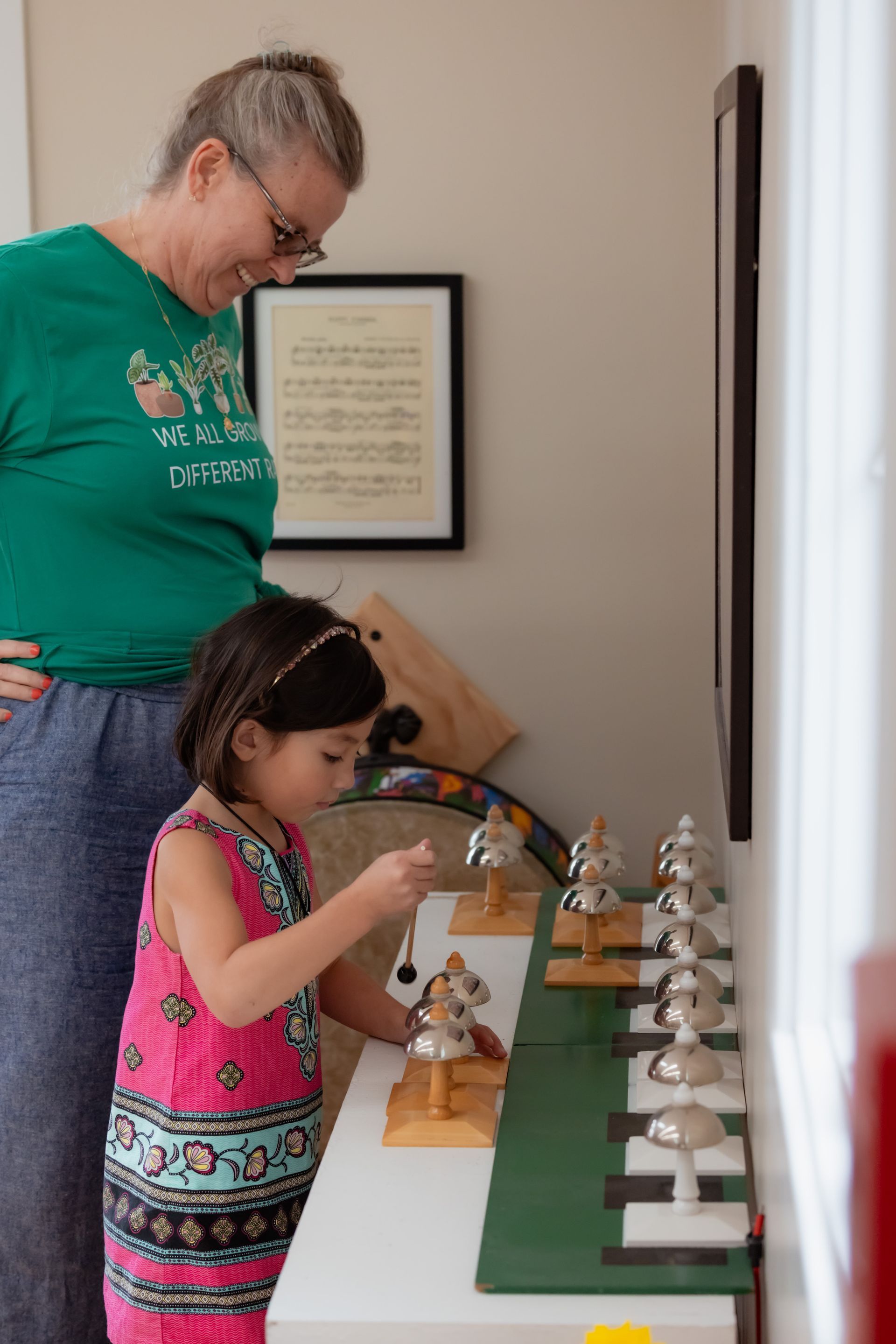
Refining the auditory sense presents a unique challenge in a vibrant, social classroom. Dr. Montessori herself noted that traditional sound materials (such as the sound boxes or Montessori bells) often require a quiet room for true isolation of sound—a condition that can be challenging to maintain in an active, collaborative environment.
The Research Study: Bringing Music to the Shelves
To address this, Dansereau (a music education researcher and Montessori parent) and Wyman (a Primary guide) designed and tested six specialized shelf activities. Using small, self-contained audio players with headphones, they allowed children to engage in isolated auditory discrimination without being disrupted by—or disrupting—the natural buzz of the classroom.
The activities were thoughtfully built around core Montessori principles:
- Self-Correction & Control of Error: A wooden tree with removable sound discs allowed children to order pitches from low to high, with built-in visual checks on the back so they could verify their own work independently.
- Pitch Direction & Movement: Children listened to rising or falling pitches and matched them to tactile 2D cards or 3D objects.
- Melodic Exploration: Listening to piano or trombone recordings, children moved a small wooden figure along a 3D pathway that visually mirrored the melody's contour.
Following traditional Montessori presentation methods, the materials were introduced via a three-period lesson and then placed on the open shelves for child-led choice. Data was gathered across six observation cycles over two years.
Key Observations: Deep Concentration and Joyful Focus
The outcomes revealed a remarkable response from the children:
“What I have witnessed... is an overwhelming need for more of this type of work. The children in my current class have demonstrated a deeper level of concentration with this work... Even my most social children go to the material and tune everything else out.”
— Brooke M. Wyman, Primary Guide & Co-Author
The researchers documented clear increases in concentration, engagement, and confidence. Wearing headphones provided a natural "veil" that allowed children to turn inward, fully immersing themselves in auditory refinement.
While the authors acknowledged the limitations of any small-scale study, the overall results demonstrate the immense value of expanding auditory choices on our Primary shelves.
Continuing the Conversation at St. John’s
At The Montessori Academy at St. John’s, we continually reflect on how our prepared environments support the whole child. This study offers a wonderful reminder of how powerful auditory refinement can be when given a dedicated space in the daily work cycle.
We would love to hear your thoughts:
- How do you notice your child responding to music and sound at home?
- What simple ways do you use to cultivate attentive listening in your daily routines?
Interested in learning more about how our guides prepare the classroom environment? Connect with our administration team or reach out to your child's guide!