Unifying Words and Their Meanings: The Quiet Genius of Montessori Vocabulary Lessons
April 6, 2026

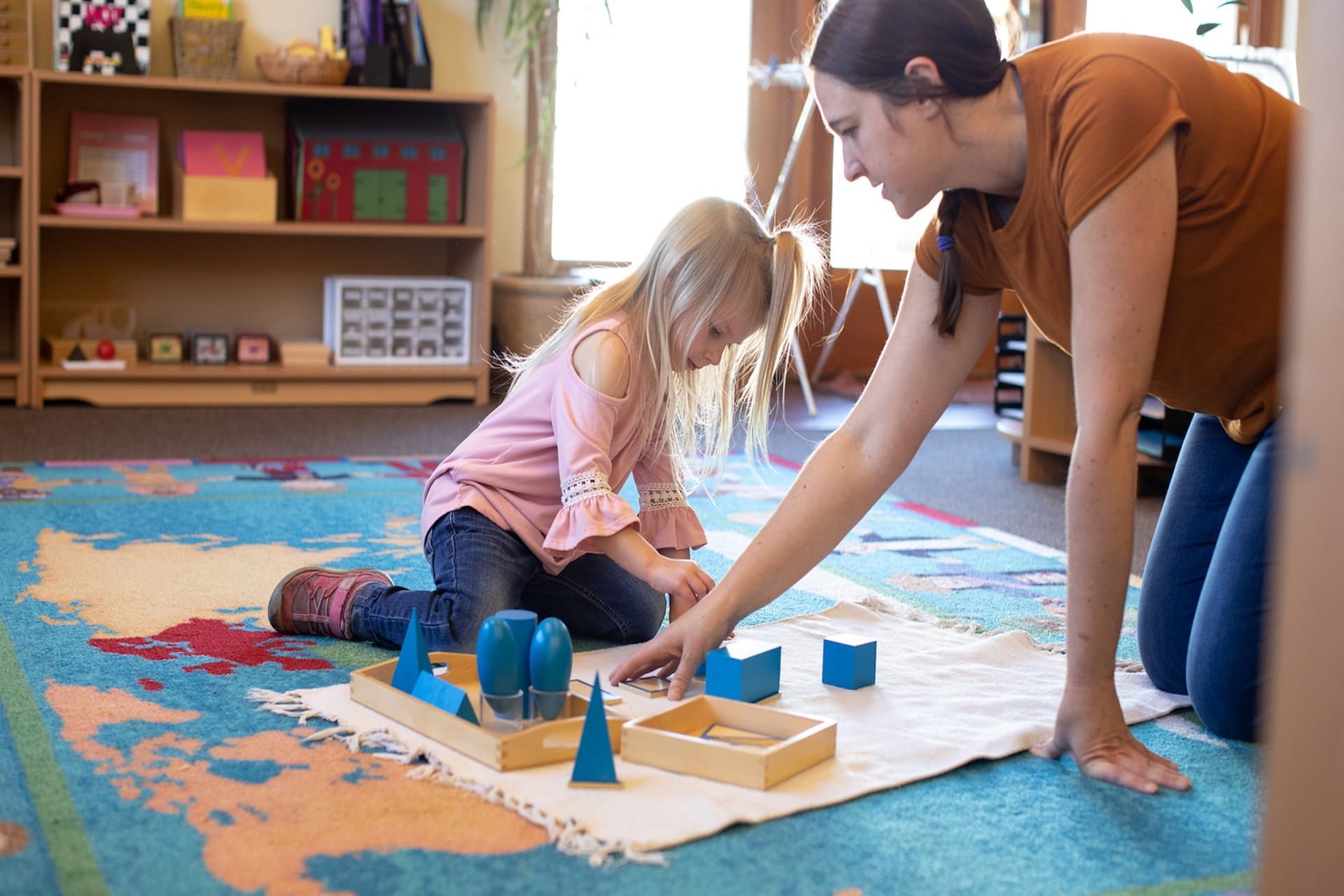
Have you ever watched a Montessori teacher give a lesson and thought, "That seemed...very short!”? If so, you may have witnessed a three-period lesson. What looks almost effortlessly simple is actually one of the most carefully designed teaching techniques.


The three-period lesson is the primary way we introduce new vocabulary to young children. We use it constantly for phonetic sounds, geometric shapes, textures, quantities, names of parts of a flower, names of continents, and so much more. Virtually every time children learn a precise new word for something they're experiencing with their senses, we are using a version of this lesson.


Why Vocabulary Needs Its Own Method


Young children are in what Dr. Montessori called a sensitive period for language. This is a window of time when children’s minds are especially primed to absorb new words and refine their understanding of them. It’s important to keep in mind, though, that absorbing a word isn't the same as truly knowing it. Children might hear the word "rough" many times without ever firmly connecting that sound to what their fingers actually feel on a piece of sandpaper.


The three-period lesson closes the understanding gap. It's built on an insight Dr. Maria Montessori borrowed from educator Édouard Séguin. Learning a word happens in stages: first association, then recognition, then recall. Moving through those stages deliberately, with no extra words or distractions to clutter the lesson, gives children's minds the clearest possible path to making a lasting connection.


“Both object and name should strike the child's understanding at the same time — but only the name itself, and not some other word, should be pronounced.”

— Dr. Maria Montessori, The Discovery of the Child


The Simplicity of the Three Stages


Here's how the three-period lesson unfolds. We’ll use a classic example of teaching the words "rough" and "smooth" with our sensorial textured boards.


1. ASSOCIATION — "This is..."


The adult presents the object and names it clearly, with no extra words. The child repeats the word while experiencing the sensation. "This is rough." The child runs their fingers across the surface and repeats: "Rough."


2. RECOGNITION — "Show me..."


After a brief pause, the adult asks the child to identify the object by name. The child simply points or touches, and thus no verbal answer is needed. "Which is smooth? Which is rough?" The child points to each in turn.


3. RECALL — "What is this?"


The adult points to an object, and the child produces the name themselves, demonstrating that the word is now truly theirs. "What is this?" The child touches the surface and answers: "Rough."


The whole lesson might take only two or three minutes, and this brevity is part of what makes it work. A child's attention is fully focused on precise vocabulary acquisition.


What Happens When a Child Gets It Wrong


One of the most quietly radical aspects of the three-period lesson is what happens when a child gets it wrong. If a child points to the wrong texture in the second stage, the adult doesn't correct. We don’t say, "no, try again.” Instead, we just end the activity gently, with the understanding that we will try the lesson again another day.


Dr. Montessori was clear about this approach. A correction at that moment doesn't help a child learn the word. In fact, a correction only reinforces the feeling of having failed. So we simply close the lesson. The child carries no impression of having gotten something wrong, and when we revisit the lesson, the child comes to it fresh.


As Dr. Montessori wrote, an error in the second period is simply a sign that the child "was not at that instant ready for the psychic association.” Nothing is wrong with the child. The teaching hasn’t failed. It just wasn’t the right moment.


After the Lesson: When Words Come Alive


One of the loveliest things to observe after a successful three-period lesson is what children do next. A child who has just learned the words "rough" and "smooth" will often wander the classroom touching things: the edge of a wooden shelf, a piece of fabric, the surface of a stone, and quietly naming the texture to themselves. The words become tools for understanding the world, and they want to use them everywhere.


This spontaneous generalization is exactly what the lesson is designed to spark. The goal is never for children to recite vocabulary on command. Rather, we want to give them language that deepens and sharpens their experience of everything around them.


Trying It at Home


You don't need Montessori materials to use this approach. Any time you want to help a young child connect a precise word to something they're experiencing (the names of spices by smell, the names of fabrics by touch, the names of tools in the garden), the same three-step structure applies. Name it clearly. Ask them to show you. Ask them to tell you. Keep it brief, keep it joyful, and if they get stuck, simply set it aside and try again tomorrow.


The lesson works because it respects how young minds learn. New connections need space, simplicity, and the freedom to form without pressure. 


To see this vocabulary tool in action, schedule a visit here in Miami Beach.

Child writing with a pencil at a table in a bright classroom
July 13, 2026
Discover how the absorbent mind shapes early childhood at The Montessori Academy at St. John’s. Learn how our prepared environments nurture your child's potential.
July 6, 2026
As parents, we quickly learn that young children hold ultimate control over three main areas of daily life: eating, sleeping, and toileting. When we lean into power struggles over these routines, it can feel exhausting for everyone involved. Instead, the Montessori approach invites us to step back and help children develop the intrinsic skills and body awareness they need to achieve true mastery over these essential functions. In our infant and toddler communities at The Montessori Academy at St. John’s, children naturally learn to prepare snack, rest when their bodies are tired, and dress themselves. Alongside these milestones, they are also developing the neurological and physical control needed to stay dry. We intentionally refer to this journey as "toilet learning" or "toilet awareness," rather than "toilet training." After all, we aren’t training our children through external conditioning. Rather, we are walking alongside them as they discover the joy of physical independence and become masters of their own bodies. While this process takes time, it does not have to feel daunting. Here is how we approach toilet learning at MASJ, and how you can mirror these practices at home. 1. Establish Body Awareness from the Beginning Toilet awareness does not start at two or three years old—it begins at birth. From the earliest days of life, we can speak respectfully to our infants about their bodies during diaper changes. Saying, "Your diaper is wet from your urine," or "I am wiping your bottom," helps them connect words to their physical sensations. To support this awareness, we highly recommend using cloth diapers or moving into cotton underwear as they enter toddlerhood. Modern disposable diapers are remarkably effective at wicking away moisture. While convenient, they often prevent a child from feeling the actual sensation of being wet, which delays the brain-to-body feedback loop. Phrases to try: "Does your diaper feel wet or dry right now?" "Your underpants feel heavy. You had a lot of pee come out." "I see you are squatting down and concentrating. Your body is working on a poop." 2. Form a True Collaboration When a child is wet or soiled, we view the diaper change or bathroom visit as an opportunity for connection, not an interruption to the day. We invite the child to actively collaborate in the process. Even young toddlers can assist by pulling down their own pants, grabbing a clean pair of underwear, or placing their soiled clothes into the laundry basket. This active participation satisfies their developmental need for functional assignment and autonomy, reducing the urge to resist. Phrases to try: "You can hold your shirt up while I help you pull down your pants." "You open this side of the diaper tabs, and I’ll open this side." "I will take a turn to wipe, and then it will be your turn." 3. State the Facts Safely and Plainly In our MASJ classrooms, our Guides stay entirely matter-of-fact throughout the toileting routine. Elimination is a completely natural bodily function, and we treat it with calm neutrality. If a child experiences an accident and wets the floor, we avoid expressions of disappointment. Similarly, when they successfully use the toilet, we avoid excessive clapping or rewards. Over-celebrating can accidentally introduce performance anxiety or make the child dependent on external praise. Instead, we acknowledge the direct reality. Phrases to try: "Pee and poop go into the toilet." "Your underpants are wet. Let’s change into dry ones. Do you remember where your clean clothes are kept?" "I see pee on the floor. Please bring me the clean-up cloth from the bathroom so we can dry the puddle together." 4. Keep the Attitude Light and Friendly Children are incredibly sensitive to adult emotions and can easily internalize our underlying stress or impatience. Maintaining a light, relaxed, and encouraging attitude ensures that children feel safe and comfortable with their normal bodily processes. We want to entirely eliminate any sense of shame, frustration, or disgust around toilet learning. Phrases to try: "We can always change into dry clothes, it's no big deal!" "Everyone used to wear diapers when they were small—even Mommy and Daddy. Now we use the toilet, and you will learn to use it too." 5. Step Away from Tricks or Treats At MASJ, we offer the toilet based on the consistent rhythms of our daily routine, but we never force a child to sit. We also tend to avoid asking open-ended questions like, "Do you want to use the toilet?" as a toddler's natural default answer is often a resounding "No!" Instead, find the comfortable middle ground by clearly stating that it is time to visit the bathroom as part of a transition (e.g., before going outside, or right after waking up). We intentionally avoid sticker charts, treats, or bribes. While these tactics can produce short-term compliance, they interfere with the long-term goal of developing genuine self-assurance and internal motivation. Trust the process and trust your child's natural drive toward mastery. Phrases to try: "It is time to walk to the bathroom and try sitting on the toilet." "You listened to your body and peed in the toilet. You did it all by yourself." Respecting the Journey When caregiving routines are rushed, children miss the opportunity to understand their own physical identity. Taking the time to slow down, communicate clearly, and invite collaboration shows the utmost respect for your child's developing personality.  By guiding your toddler through toilet learning with patience and consistency, you are helping them take a monumental step toward becoming a confident, fully independent young person. If you are currently navigating this milestone at home, remember that our AMI-trained Guides are always here to support your family. Feel free to reach out to discuss how we can beautifully bridge the routines of our school environments with your home.