We are delighted to explore one of the most iconic and beloved materials in our classrooms: the Montessori Puzzle Maps.
Beautifully crafted from wood and brightly painted, these maps can be found in both our Primary and Lower Elementary environments. While the way children interact with them evolves as they grow, our approach remains rooted in developmental appropriateness, child-led discovery, and deep respect for the child’s natural curiosity.
The Prepared Environment: The Material
If you were to walk into a classroom at The Montessori Academy at St. John’s, you would notice a specialized wooden rack holding a sequence of puzzle maps. In true Montessori fashion, the environment is meticulously prepared to move from the whole to the parts:
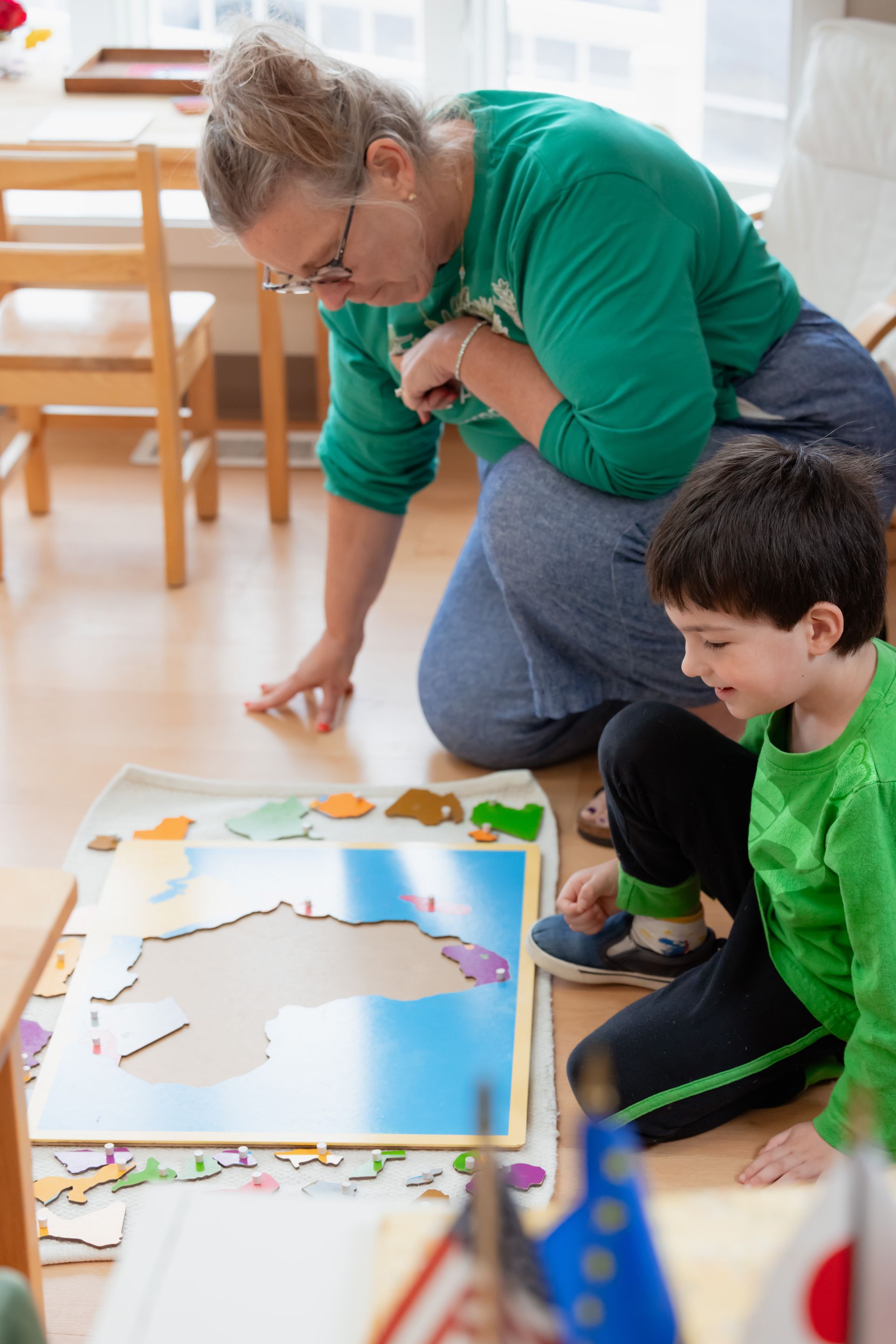
- The Planisphere: Two blue hemispheres featuring removable, brightly colored continent pieces.
- The Child’s Continent: A detailed map where each puzzle piece represents a country.
- The Child’s Country: A map where pieces indicate states or provinces.
- Other Continents of the World: Individual maps exploring every region of our globe.
Beside the rack, children have access to control maps—laminated reference maps drawn to scale. These allow the child to self-correct and verify their own work independently, fostering self-reliance and confidence.
An Gentle Introduction
A child’s journey with geography begins well before the puzzle maps. Having already explored the tactile Montessori globes—feeling the distinction between smooth water and rough landmasses—they bring a foundational understanding of our planet to this material.
Using the traditional Three-Period Lesson, a guide introduces the initial concepts:
- Presentation: The guide models how to carry the heavy puzzle safely to a work mat using both hands, gently lift each piece by its wooden knob, and place it thoughtfully on the mat.
- Recognition: The guide invites the child to point to or move specific continents ("Can you show me South America?").
- Recall: The child is invited to name the pieces independently ("What continent is this?").
Respect for the Material: A fundamental part of every lesson at MASJ is learning how to care for our shared environment. Guides explicitly show children how to replace pieces carefully and return the puzzle to its designated shelf. This instills respect, concentration, and accountability, ensuring the material is pristine for the next classmate.
The Purposeful Work
Once introduced, the child is free to return to the puzzle maps whenever their interest leads them.
To an adult, watching a child build the world map daily might look like simple repetition. In a Montessori context, however, repetition is the key to mastery and deep internal processing. We trust the child's instincts and allow them the uninterrupted time needed to fully absorb the lesson.
As children master the world map, they naturally progress to individual continents. Once the foundational procedure is understood, children are empowered to explore the remaining maps at their own pace.
Moving into Elementary: Broadening the Tools
In our Lower Elementary classrooms, the work deepens. Children begin using printed atlases alongside the wooden maps. Moving beyond standard control maps encourages them to develop essential research skills: navigating a table of contents, reading varied map keys, and cross-referencing information. We gently guide children not just to memorize facts, but to become capable, independent seekers of knowledge.
Creative Extensions & Integrated Learning
Because the puzzle maps capture the imagination so vividly, we offer a variety of extension activities to build upon their learning:
- Continent Tracing: Primary children trace each continent onto a different piece of paper, and write the name of the continent next to it.
- Map Making & Cartography: Older children enjoy carefully tracing complete maps onto large paper, hand-labeling the regions, and shading them with colored pencils.
- Continent & Cultural Studies: Puzzle maps often serve as the springboard for deep cultural exploration. A single map can launch a semester-long study into biomes, local wildlife, language, traditional music, and food.
Experience the Classroom Environment
The Montessori materials are designed to be touched, explored, and understood through movement. We invite our school community to witness this intentional design in action.
Interested in observing a classroom work cycle?
Please
schedule a tour or connect with your child’s guide to schedule a classroom observation. We would love to share more of our prepared environments with you!